Learning Outcomes:
i. Define instrumental conditioning and differentiate it from classical conditioning.
ii. Explore the work of B.F. Skinner and his experiments on operant learning in rats.
iii. Understand the key elements of instrumental conditioning: operant behavior, reinforcement, and punishment.
iv. Appreciate the real-world applications of instrumental conditioning in shaping behavior.
Introduction:
Imagine a world where learning happens not through bells and food, but through trial and error, where every action has a consequence that shapes our future choices. This is the world of instrumental conditioning, a fascinating phenomenon where we learn by doing, by exploring the consequences of our actions and adapting our behavior accordingly. In this lesson, we'll delve into the Skinner box, a stage where hungry rats became unlikely teachers, revealing the secrets of operant learning.
i. The Hungry Rat and the Lever: Skinner's Experiment
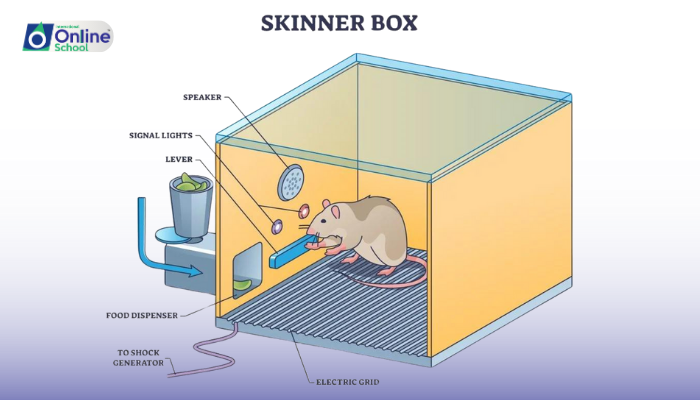
Picture a hungry rat trapped in a box with a lever. Initially, it scurries around, desperate for food. But by chance, it nudges the lever, and voila! A pellet of food pops out. This accidental reward is a powerful teacher. The rat, now understanding the connection between its action (lever press) and the consequence (food reward), repeats the behavior, learning to press the lever more and more frequently. This is the essence of instrumental conditioning: operant behaviors (lever pressing) are strengthened by reinforcement (food reward).
ii. The Dance of Reinforcement and Punishment:
Skinner's work revealed that instrumental conditioning involves more than just rewards. Punishment, in the form of unpleasant consequences, can also shape behavior. Imagine the rat pressing the lever, but instead of food, it receives a mild shock. This negative consequence discourages the behavior, prompting the rat to explore other options. The dance between reinforcement and punishment, applied carefully, can modify and shape an organism's behavior, leading to the acquisition of new skills and the extinction of unwanted ones.
iii. Beyond the Box: Applications in the Real World
Instrumental conditioning isn't confined to the laboratory. It plays a crucial role in animal training, where desired behaviors are reinforced and unwanted ones are discouraged. Imagine a dog learning to sit for a treat or a dolphin performing tricks for praise. In humans, too, instrumental conditioning helps shape behavior. Imagine a child learning to study for good grades or a teenager overcoming a fear through positive reinforcement and gradual exposure.
Skinner's work on instrumental conditioning opened a new chapter in our understanding of learning. It showed us that we are not simply passive recipients of experience; we actively explore our environment, learn from its consequences, and shape our behavior through trial and error. So, the next time you find yourself repeating a positive action or avoiding a negative one, remember the echoes of Skinner's box, a testament to the power of our choices and the constant evolution of our behavior in the dance of life.
